Amazon Vine Insightfulness Score: How to Get Excellent (and Fix “Poor”)
Excellent isn’t about writing more. Amazon checks every Vine review for four things. Hit all four, every time, and the score takes care of itself.
Here are two honest reviews of the same electric kettle.
“Nice kettle. Boils fast and looks good on the counter. Five stars.”
“A full 1.7-liter pot boils in about 4 minutes. The lid button is stiff, so it’s four stars, not five.”
The first one is pleasant and useless. The second tells a shopper exactly what to expect, and that’s the kind of review the Amazon Vine insightfulness score is built to reward. The gap between the two isn’t talent. It’s four habits.
We know they work. Our founder has written more than 1,300 Vine reviews, about 90% of them drafted with VineReviewer, and the account’s insightfulness score is Excellent. This guide shows you the four habits behind it, with real before-and-after examples, plus a two-week reset if your score says Poor right now.
The short version
- The insightfulness score grades how helpful and detailed your Vine reviews are for shoppers. It runs from Poor (red) to Excellent (green), and it feeds your tier.
- Amazon looks at four things: specific detail, context about how you used the item, sentences that stay on the product, and a reason for your stars.
- Length, photos and videos aren't required. A tight 150-word review can hit all four.
- Rejected reviews still count toward the score, so a sloppy review costs you twice.
- The fastest route to Excellent: jot notes while you use the item, then build the review from them.
What is the Amazon Vine insightfulness score?
It’s Amazon’s grade for how useful your reviews are to the people reading them. Amazon’s Vine help pages say it measures how helpful and detailed your Vine reviews are for other customers, and that it’s factored into your tier status.
It’s separate from your review rate. You can review every item you order and still score Poor, because the rate counts reviews and the score grades what’s in them. Shoppers and sellers search for it as the “review quality score” too.
- Level 1 of 4: Poor (red)
- Level 2 of 4
- Level 3 of 4
- Level 4 of 4: Excellent (green)
Our founder’s account: Excellent after more than 1,300 Vine reviews, about 90% of them drafted with VineReviewer.
- Grades
- How helpful and detailed your reviews are for shoppers
- Feeds into
- Your Silver or Gold tier status
- Doesn’t need
- A word count, photos or video
Excellent matters beyond your tier, too. Insightfulness is how you got into Vine in the first place. Amazon’s Vine page says it “selects the most insightful reviewers in the Amazon store,” and its seller page tells brands the same thing. Amazon keeps the exact formula private: the weights, the cut-offs and how often it updates. What it does publish is the four factors, and that’s all you need.
The four things that earn an Excellent score
Amazon’s help pages name four scored factors: Level of Detail, Contextualization, Topic Relevancy and Star Rating Context. Here’s what each one asks for in plain English, shown on the same kettle.
1. Level of Detail: give shoppers the numbers
Specifics a shopper can’t get from the listing: what you measured, timed or counted, and what happened when you tried it. “Works great” could describe any kettle ever sold.
- Scores low
- “Boils water fast.”
- Scores high
- “A full 1.7-liter kettle of cold tap water boils in about 4 minutes on my phone timer.”
Do this: For every item, write down one thing you measured, timed or counted.
2. Contextualization: say how you used it
How long, how often, where and for whom. Context lets a reader decide whether your experience applies to them. A kettle used once is a different story from one used every morning for three weeks.
- Scores low
- “Works great for us.”
- Scores high
- “I’ve used it every morning for three weeks, mostly for coffee and oatmeal for two people.”
Personal context counts when it changes the verdict. “My grip is weak, so a stiff button matters to me” tells some readers the review is about them. Keep it about how you use the product: Amazon’s Community Guidelines say not to share your own personal information, so leave out names, addresses and order numbers.
Do this: Open every review with one sentence on how long, how often and where you used the item.
Your notes already hold the detail and the context
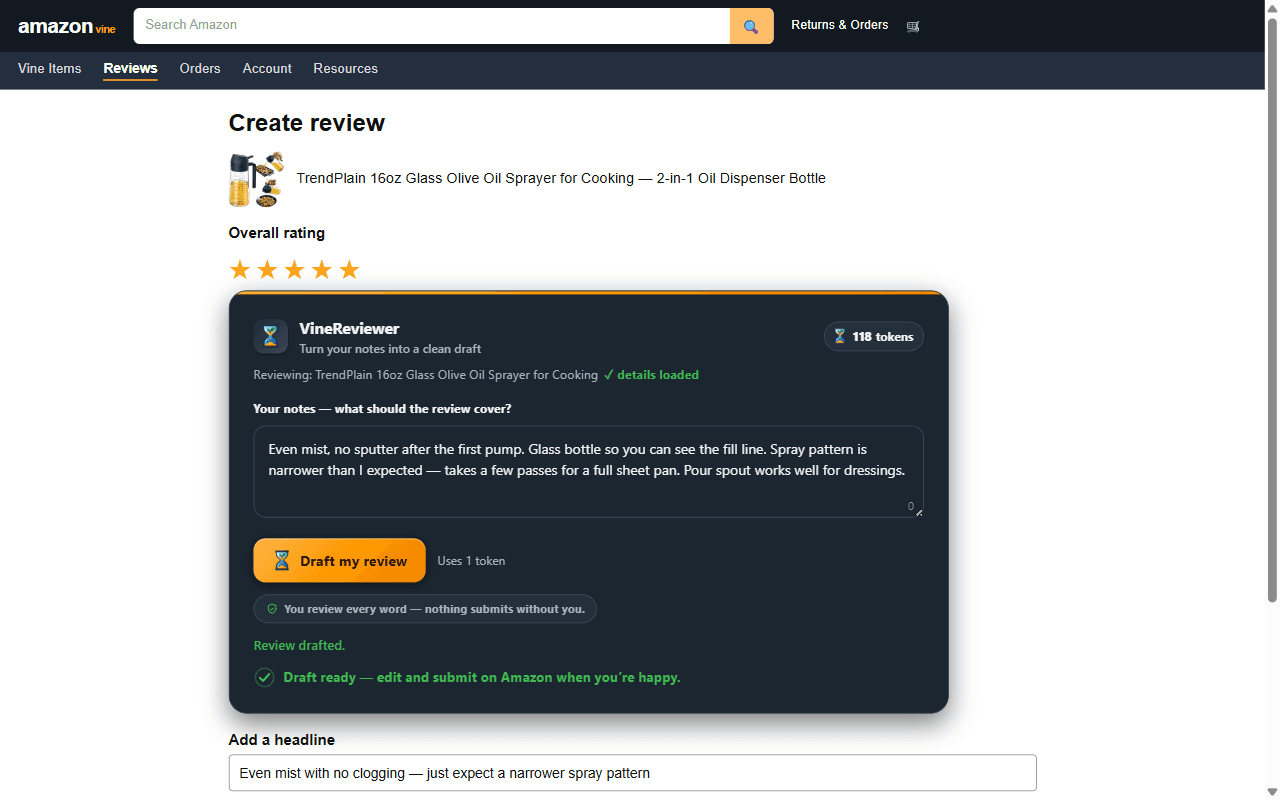
Jot what you noticed on Amazon’s Create review page, and VineReviewer turns it into a full title and review in Amazon’s own boxes. You edit every word and submit it yourself.
3. Topic Relevancy: every sentence about the product
Delivery speed, the box and the seller aren’t the product. Amazon’s help pages say shipping and packaging feedback doesn’t belong in a review, and that naming competing products or linking to outside sites can get a review rejected.
- Scores low
- “Arrived a day early, but the box was a little dented.”
- Scores high
- “After the first rinse, the water had no plastic taste. That was my main worry.”
Do this: Before you submit, delete every sentence about delivery, packaging or the seller. Compare with “my old kettle,” not a brand name.
4. Star Rating Context: explain your stars
A 3-star review should say what cost it two stars. A 5-star review should say what earned it. The fix for a weak rating isn’t a different number; it’s a reason.
- Scores low
- “The lid is kind of annoying. 4 stars.”
- Scores high
- “Four stars, not five, because the lid button is stiff. If you can press a firm button one-handed, it’s an easy five.”
Do this: End with one sentence that starts “I gave it X stars because…” and make it sound like you.
Factor 1: Level of Detail
- The question it asks
- Did you give specifics a shopper can’t get from the listing?
- Check before you submit
- Include something you measured, timed, counted or tried.
Factor 2: Contextualization
- The question it asks
- Can a reader tell whether your situation matches theirs?
- Check before you submit
- Say how long, how often, where and for whom you used it.
Factor 3: Topic Relevancy
- The question it asks
- Is every sentence about this product and what its buyers care about?
- Check before you submit
- Cut delivery, packaging and seller talk, other brands and outside links.
Factor 4: Star Rating Context
- The question it asks
- Does the text explain the stars you gave?
- Check before you submit
- Say what earned the stars and what cost them.
What doesn’t raise your score
- Length. Amazon’s help pages say there’s no word-count requirement. Filler doesn’t hit more factors. The kettle rewrite below is about 140 words, and it covers all four.
- Photos and videos. Not required either. Reviewers report that media leads to more rejections. If you add one, it must be yours: the Community Guidelines say to post only your own content or content you have permission to use.
- Gushing. “Love it!!” gives a shopper nothing to check. One timed number beats three exclamation points.
- A high star rating. The score grades your reasons, not your number. An honest 3-star review with clear reasons can hit all four factors.
Watch out: A rejected review still counts toward the score
Amazon’s help pages say reviews that aren’t approved still count toward your insightfulness score. So a sloppy review costs you twice: it doesn’t help your review rate, and it still drags on the score. See what to do with a Vine review marked Not Approved.
Before and after: the same kettle, rewritten
Same kettle, same three weeks, same 4 stars. The rewrite adds no new opinions. It adds what the reviewer already knew but didn’t write down, and every sentence is tagged with the factor it hits.
BeforeVague, 4 stars
Nice kettle. Arrived fast and the box was only a little dented. Boils fast and looks good on the counter. The lid is kind of annoying.
What each factor finds missing
- Level of Detail“Boils fast” gives no time, size or comparison.
- ContextualizationNothing says how long, how often or by whom it was used.
- Topic RelevancyOne of four sentences is about delivery and the box, not the kettle.
- Star Rating Context“Kind of annoying” doesn’t say what cost the fifth star.
AfterSame kettle, same 4 stars
Fast, quiet boil, but the lid button is stiff
- I’ve used this 1.7-liter kettle every morning for three weeks, mostly for coffee and oatmeal for two people.Factors: Contextualization
- A full kettle of cold tap water boils in about 4 minutes on my phone timer. One mug’s worth takes just over a minute.Factors: Level of Detail
- It’s quieter than my old kettle. I can still hear the radio while it runs, and it switches off by itself.Factors: Level of DetailContextualization
- After the first rinse, the water had no plastic taste, which was my main worry.Factors: Topic RelevancyLevel of Detail
- The cord is short, about 2.5 feet, so the kettle has to sit close to an outlet.Factors: Level of DetailTopic Relevancy
- The lid button is stiff. My grip is weak, so I hold the handle with one hand and press the button with the other.Factors: Level of DetailContextualization
- Four stars, not five, because of that lid. If you can press a firm button one-handed, it’s an easy five.Factors: Star Rating Context
Nothing about delivery or the box. The lost star now has a reason.
The verdict didn’t change. What changed is that every sentence now gives a shopper something to check against their own kitchen, the delivery talk is gone, and the missing star has a reason.
How our reviews stay at Excellent
Our founder’s Vine account has more than 1,300 reviews, and about 90% of them were drafted with VineReviewer. The insightfulness score on that account is Excellent. That isn’t luck. It’s the four factors, built into how the drafter works:
- It starts from your notes. The detail and the context come from what you saw, not from the listing.
- It keeps every specific you type. The 4-minute boil, the stiff button and the short cord all make it into the draft.
- It stays on the product. It leaves out shipping and delivery comments, and it doesn’t invent comparisons with other brands.
- You stay in charge. The title and review appear in Amazon’s own boxes. You edit every word, set your stars and click Submit yourself.
Score says Poor? The two-week reset
- Day 1: grade your last five reviews. Check them against the scorecard above. The factor you miss most often is your first fix.
- From today: take a 30-second note per item. While you use it, add how long and where you used it, one number, one surprise and one complaint.
- Every new review: context, details, stars. Open with how you used it, give the specifics, and end with your stars and the reason. The Vine review template lays out the structure.
- Before Submit: clean it. Delete delivery and packaging talk, other brand names and any outside links.
- In two weeks: check your account page. Amazon doesn’t say how often it recalculates, so if the score hasn’t moved yet, keep going. New reviews are what move it.
Tip: Don’t clear a backlog with thin reviews
Rushing ten short reviews to protect your review rate works against the score, and rejected ones still count. If time is the problem, see how to write Vine reviews faster.
Can ChatGPT get you to Excellent?
Not on its own. Ask a chatbot to “write an insightful review of this kettle” and it only knows the listing, so every boil time and taste note it adds is made up. Amazon’s Community Guidelines say “Reviews should be based on actual experience with the product,” and its Vine help page says Voices are expected to use products before reviewing them.
A tool helps only when it starts from your own notes. Then the detail, the context and the reason for your stars are still yours. For the full picture, read is AI allowed for Amazon Vine reviews?
Key point: One test for any draft
For each factual sentence, ask: did I see, measure or feel this myself? If not, delete it, no matter who or what wrote it.
Frequently asked questions
How do I get an Excellent insightfulness score on Amazon Vine?
Hit the four things Amazon's Vine help pages say the score looks at, in every review: specific detail, context about how you used the item, sentences that stay on the product, and a reason for your star rating. The easiest way to do that is to jot a few notes while you use each item and build the review from them.
Do longer Vine reviews get a better insightfulness score?
Not by length alone. Amazon's Vine help pages say the score has no word-count requirement. Extra words help only when they add detail, context or a reason for your stars. A tight review of about 150 words can cover all four.
Do I need photos or videos to raise my insightfulness score?
No. Amazon's Vine help pages say there's no image or video requirement. Reviewers report that photos and videos lead to more rejections, and rejected reviews still count toward the score. Add a photo only when it shows something words can't, and only if it's your own.
Can a Poor insightfulness score get my Vine account closed?
Amazon's Vine help pages say the score is factored into your tier status. The closure rule they spell out is the 60% review rate: below it, the account goes under review and can be closed after 30 days of monitoring. So a Poor score is a tier problem to fix now, not a closure notice.
How long does it take to go from Poor to Excellent?
Amazon doesn't publish how often the score updates or how many reviews it looks at. Write every new review to the four factors, then check your Vine account page every couple of weeks. The reviews you write from today are the ones that move it.
Can ChatGPT write an Excellent Amazon Vine review for me?
Not from the listing alone. Amazon's Community Guidelines say reviews should be based on actual experience with the product, and a chatbot that only sees the listing has to make up the details. A tool helps only when it starts from your own notes, and you check and edit the draft before you submit.
Sources
- Amazon Vine Help (sign-in required): the score’s levels and factors, the word-count and media rules, rejected reviews, tier status, the 60% rule and the shipping-feedback rule.
- Amazon Vine: about the program
- Amazon Vine for sellers
- Amazon Community Guidelines
- Amazon Help: Amazon Vine